Designing Edge Ingest So Monitoring Stays Fast, Cheap, and Honest
The cheapest bad event is the one you never process. Edge ingest design decides whether your monitoring system scales operationally or quietly leaks cost.
On this page
Ingest is where your product model, cost model, and reliability model collide. If you get this layer wrong, everything downstream becomes slower and more expensive.
Every inactive org, bad key, or malformed payload that makes it to queues and analysis workers costs more than it should and teaches the wrong lesson about product discipline.
A lot of pipelines validate too late. They accept first, enrich later, and only discover after queueing that the org is inactive, the key is invalid, or the payload is useless.
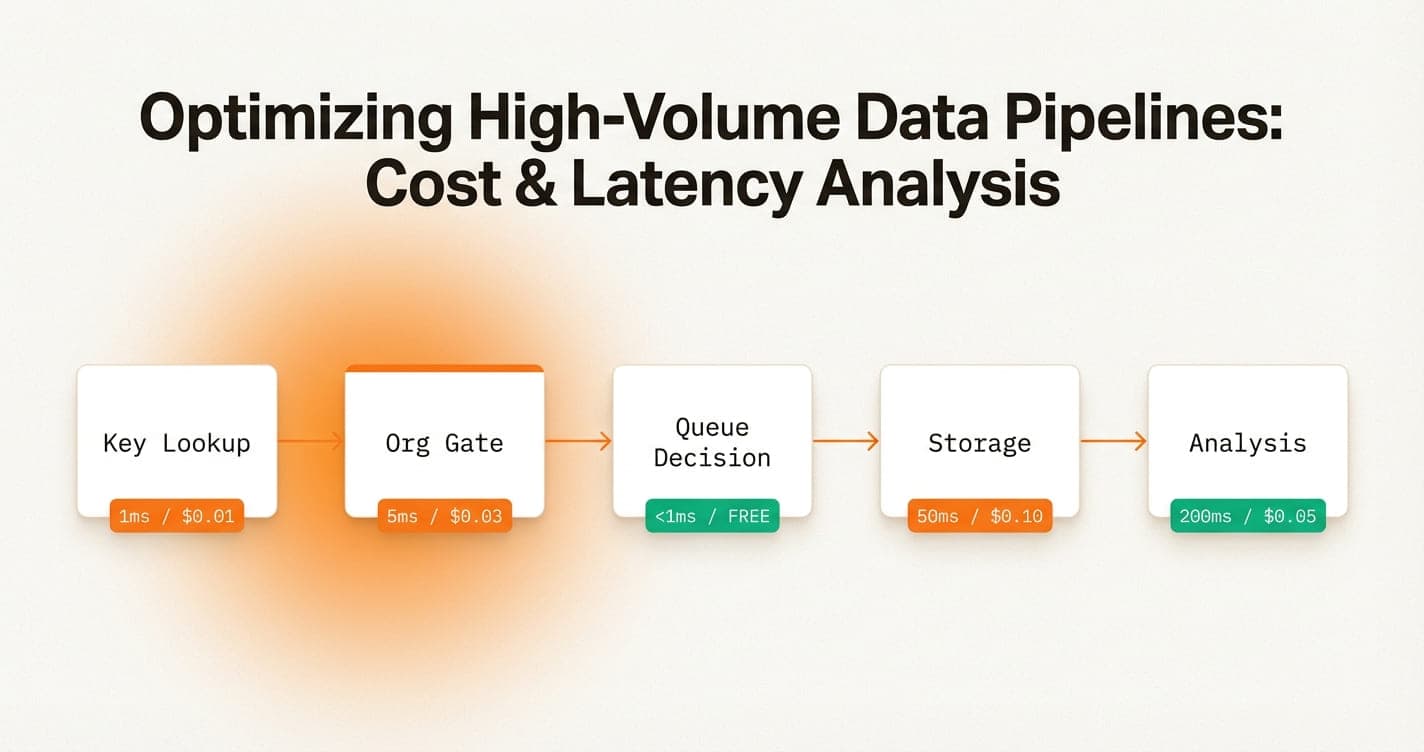
A better ingest path does the cheap truth checks first: resolve the project, resolve the org state, decide whether the event is allowed, and only then hand work to the rest of the system.
What the real failure path looks like
Ingest is where your product model, cost model, and reliability model collide. If you get this layer wrong, everything downstream becomes slower and more expensive. The operational question is not whether an event exists. The question is whether the right part of the system can see it early enough to make a good decision.
That is why architecture matters here. The ingest path, the grouping model, and the issue surface all shape whether the product feels calm or fragmented under pressure.
What this architecture has to achieve
Where teams usually lose the signal
A lot of pipelines validate too late. They accept first, enrich later, and only discover after queueing that the org is inactive, the key is invalid, or the payload is useless.
That creates a brittle operating model. People end up correlating logs, screenshots, and chat fragments instead of opening one incident view that already contains the important evidence.
The result is not just slower debugging. It is weaker product judgment, because the team still does not know whether the incident is small, systemic, or already resolved.
Typical setup versus a stronger setup
The goal is not more tooling. The goal is fewer mental joins during a live incident.
A cleaner implementation path
A better ingest path does the cheap truth checks first: resolve the project, resolve the org state, decide whether the event is allowed, and only then hand work to the rest of the system.
The clean implementation path usually has three moves: instrument the important runtime, normalize the incident into a readable issue model, and verify the full loop with a deliberate test event.
A practical rollout path
Capture the right runtime first
Start with the runtime that can break the most important user journey. That might be the browser, an API surface, an edge function, or a Worker fetch handler.
Keep the setup narrow and explicit
Write the setup in one place, keep the key in the right secret store, and avoid copying half-finished snippets around the codebase.
const orgStatus = await readOrgStatus(env, project.orgId)
if (!orgStatus.active) {
  return new Response(JSON.stringify({ accepted: true }), { status: 202 })
}

await env.EVENT_QUEUE.send(event)Verify the full issue loop
Trigger a deliberate failure and make sure the resulting issue is readable enough that a teammate who did not write the route can still act on it.
What to keep visible after launch
Once the pipeline is live, the next job is not to add every advanced feature. It is to keep the incident surface readable: summary, route, runtime, user impact, and next action.
That is what lets architecture turn into product leverage instead of background plumbing.
Architecture review checklist
- ✓Resolve key to project before expensive work.
- ✓Read org access state before queueing.
- ✓Return SDK-safe responses even when dropping.
- ✓Keep replay and issue pipelines aligned to the same access truth.
- ✓Cache status aggressively but refresh it on billing changes.
Common questions
Where VybeSec fits
VybeSec is designed around this exact path: capture the signal where it happens, normalize it into one readable issue flow, and keep the client-side and server-side context connected so the incident stays understandable.
That is what makes the product useful to founders and small teams. The architecture is there to reduce operational drag, not to create another layer of technical ceremony.
Want the product notes and access updates?
Join the waitlist if you want a monitoring product built around real production response loops instead of raw log sprawl.
Stay close
Want practical setup playbooks like this?
We publish implementation guides for client and server monitoring, alerting, and fix workflows you can ship quickly.
Related posts