A Practical Monitoring Guide for Next.js App Router Projects
App Router projects mix server and client boundaries in ways that look elegant in code and messy in production incidents. This is the monitoring setup that keeps them readable.
On this page
App Router gives teams a strong composition model, but its mixed execution contexts create debugging blind spots if monitoring is bolted on casually.
You can have a clean codebase and still end up with confusing incidents because the same failure crosses client components, route handlers, and server runtime edges.
The common mistake is to instrument one half and assume the framework will make the rest obvious. It does not.
Treat the app as a multi-runtime product and wire monitoring accordingly, while keeping the issue model unified for the humans reading it later.
Why teams delay this work and regret it later
Teams postpone monitoring because the app looks calm before launch and because setup feels like work that can always happen tomorrow.
That logic breaks down once a real incident lands. At that point the team is trying to learn the product and build the monitoring workflow at the same time, which is the expensive order to do it in.
Start with the path that can actually fail
App Router gives teams a strong composition model, but its mixed execution contexts create debugging blind spots if monitoring is bolted on casually. This is why copy-pasting a generic snippet is not enough. You need the setup to match the runtime where the most important user journey can break.
That still does not mean the integration should be heavy. It means the first setup should be intentional enough that the resulting issue is useful.
A practical setup path
Choose the primary runtime
Pick the browser, server, edge function, or mobile runtime that sits closest to your riskiest user path.
Install the narrowest useful integration
Add the smallest explicit integration that captures that runtime cleanly and reviewably.
"use client"
import { useEffect } from "react"
import { init } from "@vybesec/sdk"

export function VybeSecProvider() {
  useEffect(() => {
    init({ key: process.env.NEXT_PUBLIC_VYBESEC_KEY, platform: "nextjs" })
  }, [])
  return null
}Trigger a deliberate test issue
Test the full loop from the real app, not only from an isolated snippet or platform log screen.
What teams usually skip in the verification step
A green install is not the same thing as a useful setup. The workflow only becomes real when the team can see a deliberate failure arrive with the route, runtime, and release context intact.
That is why the verification step deserves real attention. It is where you discover whether the product will help later or just look integrated today.
What to verify before you call it done
Treat the app as a multi-runtime product and wire monitoring accordingly, while keeping the issue model unified for the humans reading it later.
A good verification step proves more than installation. It proves that the right route, runtime, and error path all arrive in a readable incident view.
Verification checklist
- ✓Initialize the client boundary clearly.
- ✓Enable server/runtime instrumentation explicitly.
- ✓Keep route metadata attached to events.
- ✓Verify the error path with a real request flow.
- ✓Make the resulting issue readable by someone who did not write the route.
Common questions
Where VybeSec fits
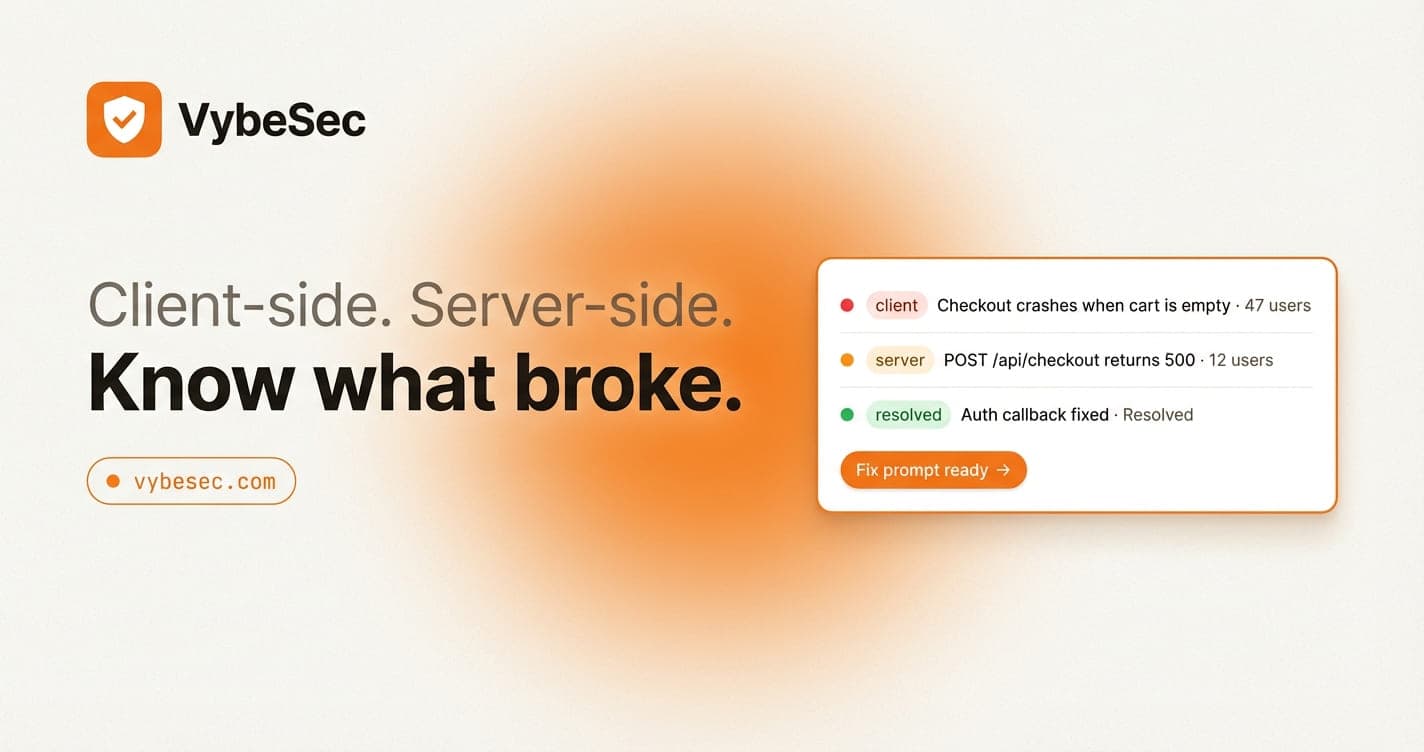
VybeSec is built to make this setup narrow but useful. The onboarding path distinguishes client and backend work, the snippets stay copyable, and the first real issue lands in a dashboard designed to be readable by the whole team.
That matters because a fast setup is only valuable when it leads to a reliable debugging loop later.
Want early access and more setup guides?
Join the waitlist if you want a monitoring workflow that fits modern builders, framework teams, and fast-moving product engineers.
Stay close
Want practical setup playbooks like this?
We publish implementation guides for client and server monitoring, alerting, and fix workflows you can ship quickly.
Related posts