What a Security Score Should Actually Mean in an AI-Built App
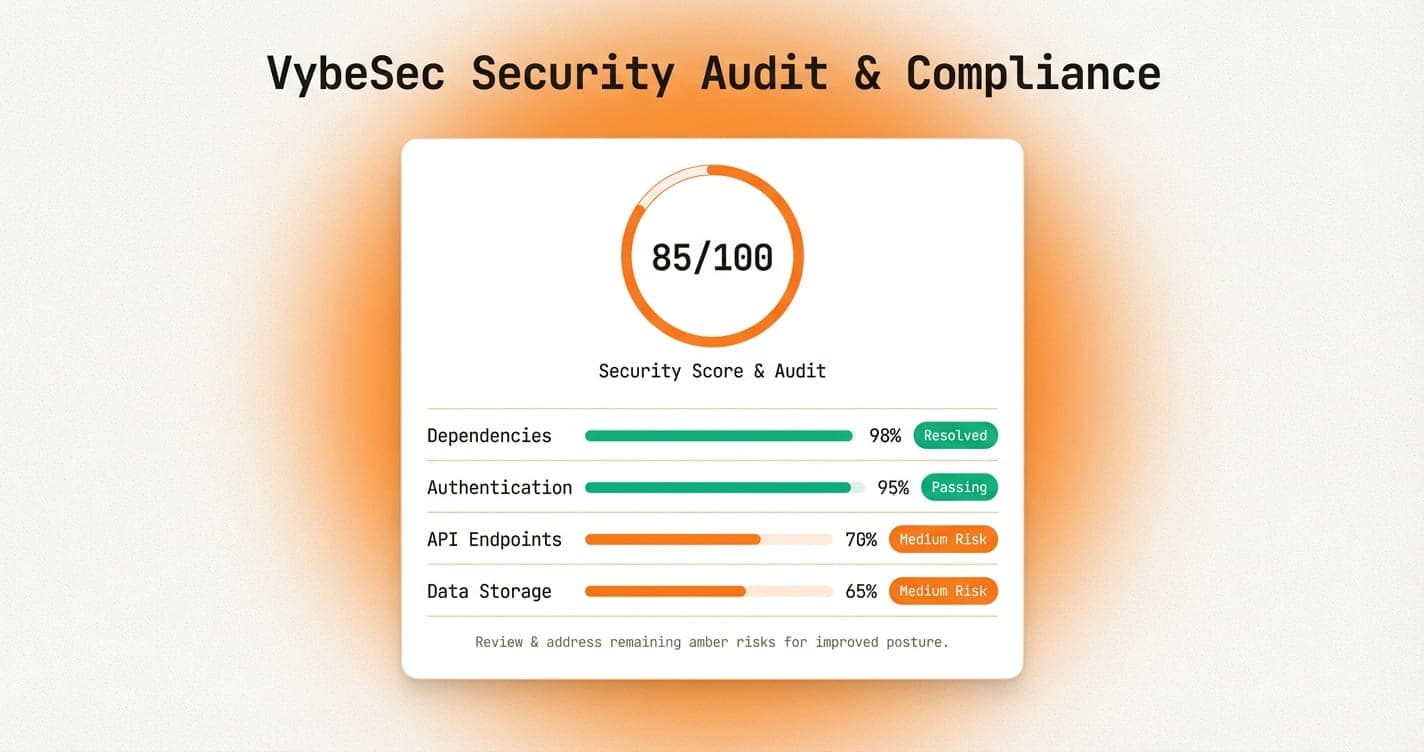
A security score is only useful if it compresses real risk into a decision. This is how to think about score design without turning it into vanity UI.
On this page
Security scores are often presented as marketing gloss, but founders still need a fast way to tell whether their app has a meaningful auth or data-handling risk.
If the score is too vague, it gets ignored. If it is too technical, it becomes another screen the founder never opens again.
Security tooling often forces small teams to choose between simplistic badges and extremely noisy scanner output. Neither is helpful during a launch window.
Security score
A compressed signal that summarizes the current risk posture of an application based on weighted findings, not on vanity checklists.
Example: Use the score to decide what needs review this week, not to replace the review itself.
What security teams and founders usually see too late
Security scores are often presented as marketing gloss, but founders still need a fast way to tell whether their app has a meaningful auth or data-handling risk. A finding only becomes useful when it is tied to product behavior: which route, what kind of access, what data, and what likely blast radius.
Without that context, small teams either overreact to noise or underreact to risk. Neither outcome is acceptable in a product that handles real users and real data.
What a useful security surface should do
Where scanners usually fall short
Security tooling often forces small teams to choose between simplistic badges and extremely noisy scanner output. Neither is helpful during a launch window.
The fix is not to throw scanners away. The fix is to wrap them in a product model that can explain why a finding matters and who on the team needs to care.
Three ways teams experience security output
A practical review flow for a small team
A useful score should compress the state of authentication, exposed secrets, sensitive route handling, and basic misconfiguration into a readable signal that leads to action.
That is how security becomes operationally useful for AI-built apps. It shows the risk clearly enough that a founder or product engineer can choose what to fix first without pretending to run a full enterprise security practice.
A practical review path
Surface the top-level signal
Start with the readable signal: score movement, issue severity, and the part of the product under review.
Tie findings to routes and assumptions
For each important finding, preserve the route, auth assumption, and the type of user data or capability involved.
Move the team into remediation
Only then move into the detailed fix path so the team is solving the right problem, not just the loudest one.
Security review checklist
- ✓Weight authentication issues higher than cosmetic findings.
- ✓Show why the score moved, not just the number.
- ✓Separate visible signal from detailed remediation if plan state requires it.
- ✓Keep the explanation readable by non-specialists.
- ✓Tie findings back to actual routes or assets in the app.
Common questions
Where VybeSec fits
VybeSec treats security as a readable product surface. The score stays understandable, the findings stay tied to routes and risk, and the dashboard can expose or lock remediation layers cleanly based on account state.
That gives small teams a more defensible workflow than either opaque scanner output or empty badge design.
Want the next security and product notes?
Join the waitlist if you want security visibility designed for AI-built apps and small product teams.
Stay close
Want clearer security + reliability signals?
Get practical notes on security findings, incident context, and monitoring workflows that teams can actually act on.
Related posts