Choosing Monitoring for an AI-Built Product: A Founder’s Guide
The right monitoring product for an AI-built app is not the one with the most knobs. It is the one that turns incidents into decisions without adding operational drag.
On this page
Founders evaluating monitoring often compare feature lists when they should be comparing workflows: how fast does the product help me understand, triage, and repair a live failure? That is why products built fast often feel stable until the first wave of real users arrives.
Every extra translation step is expensive in a small team. You need a system that fits how AI-built products are actually shipped and maintained.
Traditional monitoring evaluations over-index on knobs, dashboards, and raw data. They underweight readability, repair velocity, and founder-friendly issue design.
"The first live error tells you whether the product is a system yet or still just a demo.
"
VybeSec note
Operator lens
The invisible cost of a weak response loop
A weak monitoring loop does more than slow debugging. It changes product behavior. Teams hesitate to ship follow-up fixes, support conversations get fuzzier, and founders start treating incidents as interruptions instead of product feedback.
That is why the shape of the incident workflow matters so much early. The system is training the team how to respond every time something breaks.
Why this gets painful faster than people expect
Founders evaluating monitoring often compare feature lists when they should be comparing workflows: how fast does the product help me understand, triage, and repair a live failure? Local confidence is usually built on curated flows, known data, and the one device the builder already has open.
Every extra translation step is expensive in a small team. You need a system that fits how AI-built products are actually shipped and maintained. Production introduces old sessions, strange payloads, mobile browsers, retries, hidden backend paths, and impatient users.
matters most: does this product help me move from incident to decision faster?
What most teams do instead
Traditional monitoring evaluations over-index on knobs, dashboards, and raw data. They underweight readability, repair velocity, and founder-friendly issue design.
The team then rebuilds the story manually: a screenshot from support, a Slack thread, a vague reproduction path, maybe one browser console dump, and a lot of inference.
That workflow scales the confusion faster than it scales understanding. It makes every responder start from scratch.
A weak response loop versus a durable one
What to set up before you need it
The better evaluation asks whether the product connects browser and server signal, explains incidents clearly, and shortens the path to the next safe fix.
The goal is not to create a giant observability program. The goal is to create one reliable path from incident to decision, then let everything else layer on top of it.
Week-one monitoring checklist
- ✓Can it explain issues in plain English?
- ✓Can it capture both client and server failures?
- ✓Does it show who was affected?
- ✓Does it help with the repair workflow?
- ✓Does the pricing boundary align with actual product behavior?
The dashboard a founder actually needs
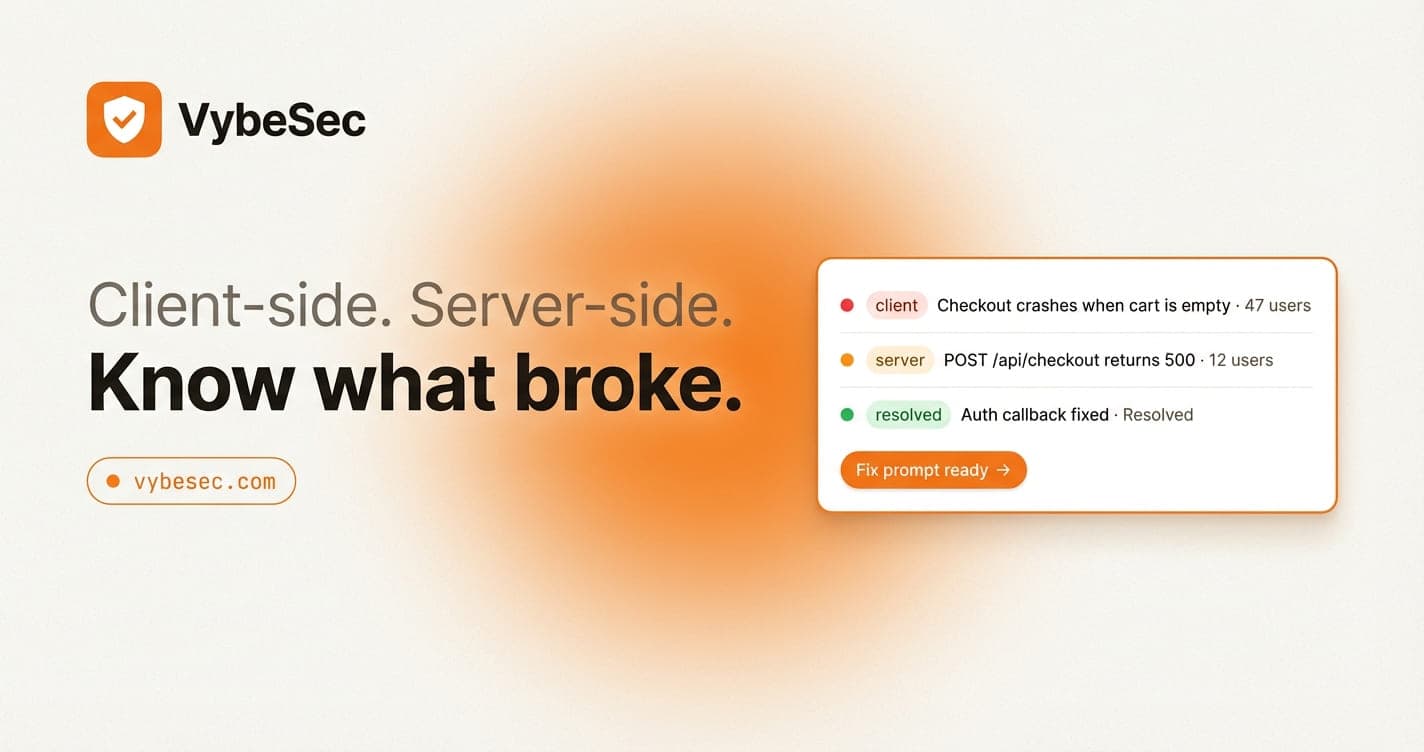
A founder-friendly monitoring surface should not ask the reader to parse raw traces first. It should lead with the issue summary, the runtime, the user impact, and whether the incident is still active.
That is the point where monitoring becomes a product tool instead of a specialist-only console. The founder can make a decision quickly, and the engineer still has the evidence one click deeper.
Common questions
Where product discipline actually shows up
Product discipline shows up in what the dashboard refuses to make the user infer. The more a reader has to reconstruct alone, the less the page is acting like a real product surface.
That is why clarity, issue grouping, and sensible hierarchy matter so much here. They are not cosmetic. They determine whether the tool gets used when pressure is high.
Where VybeSec fits
VybeSec is built around that operating model. It captures the live incident, explains it in plain English, keeps the client and server sides connected, and lets the team move toward the fix without rebuilding context from scratch.
That is the real promise: not more noise, but a tighter path from production failure to confident action.
Want launch updates and early access?
If you are building fast and want a monitoring workflow designed for founders and small engineering teams, join the waitlist for the next VybeSec access wave.
Stay close
Want founder-ready monitoring insights?
Get concise operating notes on launch risk, incident response, and the product decisions behind resilient AI-built apps.
Related posts